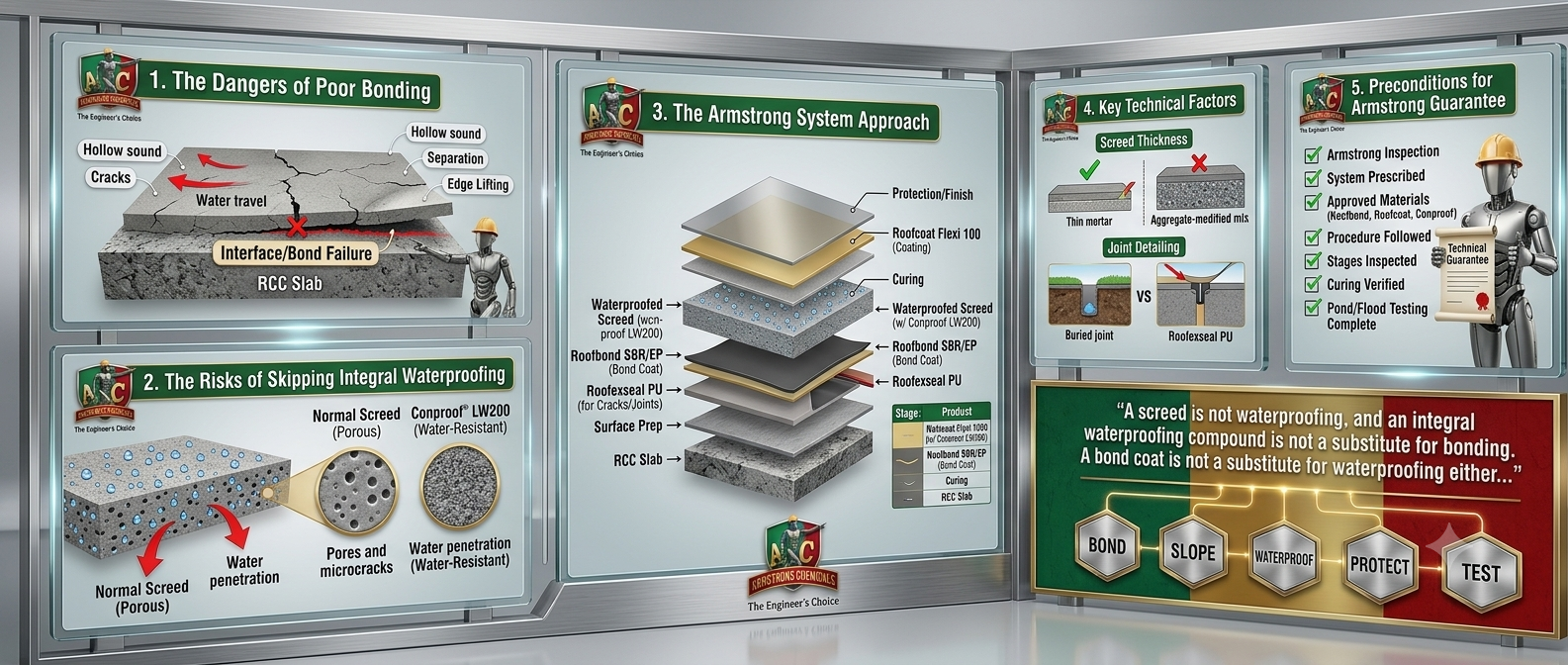
1. What happens if screed is simply laid on the old RCC slab?
The most important danger is interface/bond failure. Hardened RCC and newly placed screed do not automatically develop dependable adhesion.
If the slab is smooth, dusty, contaminated, laitance-covered or dry, and no suitable bonding treatment is provided, the screed may initially appear sound but later become partially or completely hollow.
Typical symptoms
- Hollow or drummy sound when tapped
- Separation between screed and mother slab
- Cracks appearing on the screed
- Edge lifting or local delamination
- Water travelling horizontally between screed and slab
- Dampness appearing away from the water-entry point
- Screed breaking or coming out in patches in severe cases
Bonding is a structural interface issue. An integral waterproofing admixture cannot replace a bond coat.
2. What happens if integral waterproofing compound is not added?
A normal cement-sand screed contains interconnected pores and may develop drying-shrinkage microcracks. Water can penetrate through these pores and cracks.
A properly selected integral waterproofing admixture can help reduce permeability and improve the water resistance and workability of the screed, depending on its chemistry and correct dosage.
However, an integral waterproofing compound alone does not make a terrace completely waterproof. It is one component of the waterproofing system, not a substitute for crack treatment, proper slope, joints, bond coat, membrane or coating, and curing.
3. The Armstrong approach
For dependable terrace work, Armstrong recommends a multi-barrier approach rather than dependence on plain screed.
| Stage | Armstrong product |
|---|---|
| Movement cracks/joints, where suitable | ROOFEXSEAL PU 212 |
| Bonding system | ROOFBOND SBR 401, ROOFBOND PB 210 or ROOFBOND EP |
| Integral waterproofing in screed | CONPROOF LW 200 or an appropriate integral admixture |
| Waterproofing coating | ROOFCOAT FLEXI 100 or another system suited to the exposure |
The exact bonding product and application method must be selected according to the substrate and screed specification. Where a wet-on-wet bonding system is specified, the screed must be placed within the product's permitted open time, before the bonding layer becomes unsuitable for bonding.
4. Screed thickness also matters
A very thick cement-sand mortar should not simply be placed to correct major slope variations. Increasing mortar thickness increases shrinkage and cracking risk.
Where substantial thickness is required, the mix design should be modified appropriately, for example by using suitable graded aggregate rather than a thick, cement-rich mortar layer.
Construction and movement joints in the mother slab should not simply be buried under a rigid screed. They require appropriate detailing.
The terrace must have positive drainage. Waterproofing should never be used as a substitute for proper slope.
Can Armstrong give a guarantee without these precautions?
No, not an unconditional waterproofing guarantee.
If a contractor lays ordinary screed directly on the mother slab without specified surface preparation and bonding, crack and joint treatment, integral waterproofing where specified, proper slope and curing, and the designed waterproofing treatment, Armstrong cannot guarantee the complete terrace merely because one Armstrong material was used somewhere in the work.
A technically defensible guarantee is issued only when:
- Armstrong engineers inspect and approve the substrate
- The complete system is prescribed
- Approved materials are used at the specified consumption
- The application procedure is followed
- Critical stages are inspected and documented
- Curing and drainage requirements are satisfied
- Final pond or flood testing is successfully completed where appropriate
A message for builders and engineers
“A screed is not waterproofing, and an integral waterproofing compound is not a substitute for bonding. A bond coat is not a substitute for waterproofing either. Each layer has a different function. Long-lasting terrace protection comes from treating the entire slab–screed–waterproofing system correctly.”
Frequently asked questions
For the complete terrace sequence, see the Roof Waterproofing Guide.
© 2026 Armstrong Chemicals Pvt Ltd. All rights reserved.