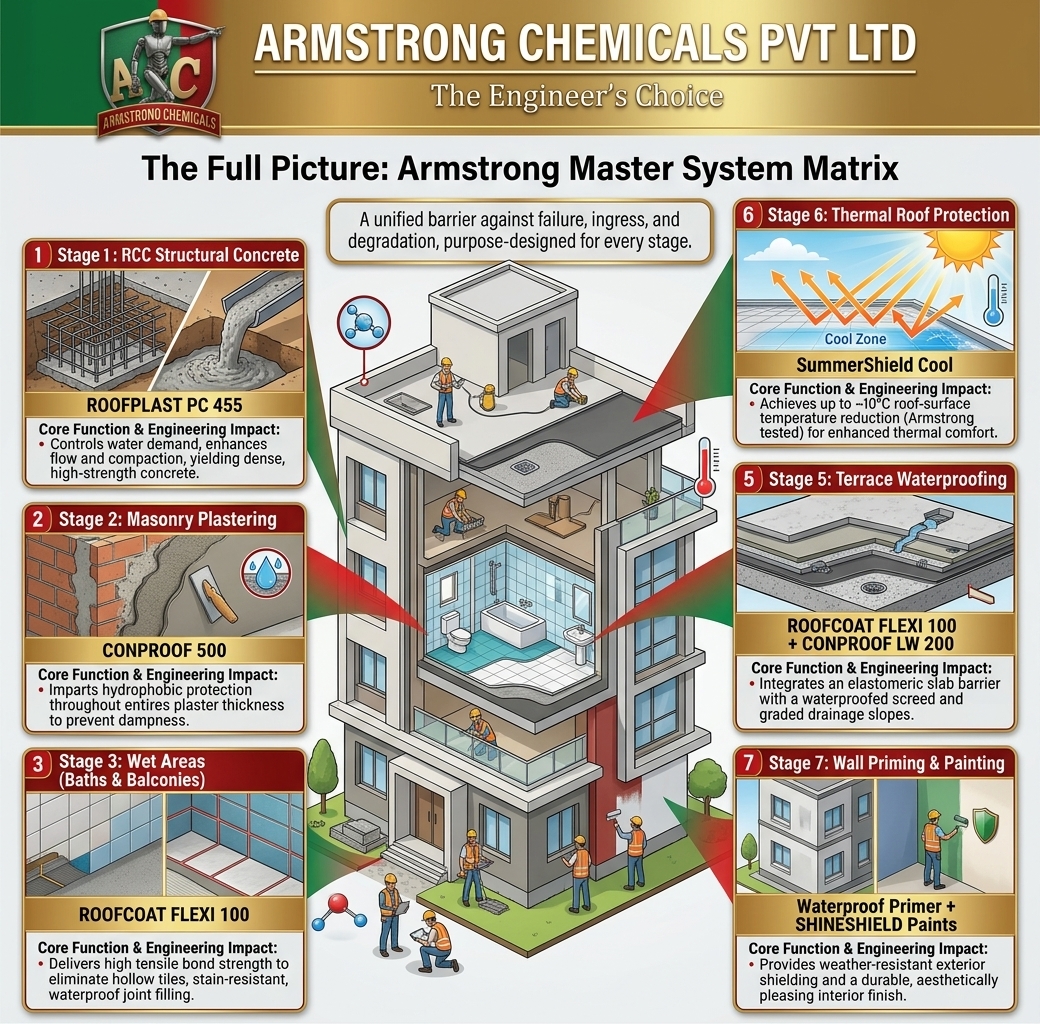
Most homebuyers judge a building by what they can see on the day of handover — the paint finish, the tiling, the fittings. By the time any of that is visible, however, the decisions that actually determine whether the building stays strong, dry and durable for decades have already been made and buried, quite literally, inside the concrete, the plaster and the terrace slab. A builder who wants to demonstrate real value to a customer has to make that invisible work visible — walking them through the site, stage by stage, and showing exactly what has gone into the structure before the finishes ever go on.
This article sets out that walkthrough as Armstrong intends it to be told: a builder personally guiding a customer through a building under construction, explaining how ARMSTRONG Construction & Waterproofing Chemicals are used at every critical stage — from the structural concrete itself through to the final coat of paint — to deliver a building that is strong, waterproof, cool, beautiful and durable.
Why an Integrated System Matters
A dependable building is not created by waiting for cracks, dampness or leakage to appear and then repairing them after the fact. It is created by treating prevention as part of construction itself, at every stage, rather than as an afterthought once problems surface. That is the principle behind an integrated Armstrong system — each product in the range is chosen to solve a specific, well-understood failure mode at a specific stage of construction, so that the finished building has no untreated weak points hiding behind its finishes.
This stage-led approach applies to any construction project — residential, commercial or industrial — built under Indian climatic conditions: specify the right treatment for each stage's actual substrate, exposure and construction sequence, rather than relying on one general-purpose product to cover every risk.
Stage 1 — RCC Structural Concrete
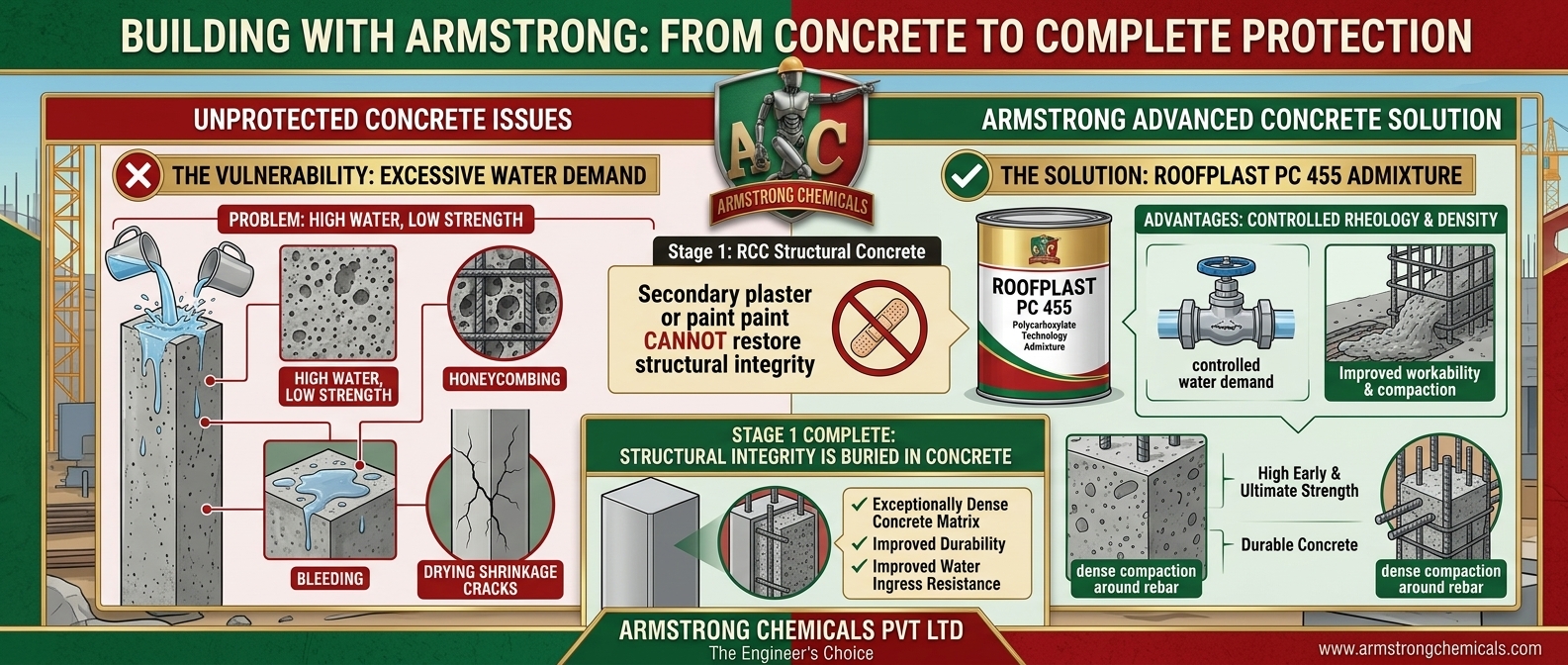
The walkthrough begins where every building does: at the RCC columns, beams and slabs. A customer asking how a builder ensures good strength and long-term durability is really asking about the concrete itself — because no amount of finishing work later can compensate for weak, porous or poorly compacted structural concrete.
For structural concrete, ROOFPLAST PC 455, a Polycarboxylate Technology concrete admixture, is used to achieve excellent workability with controlled water demand, better compaction and dense, durable concrete. A strong building must start with properly designed and executed concrete — everything that follows depends on getting this stage right.
ROOFPLAST PC 455 — Better Workability • Controlled Water Demand • Dense Concrete • High Strength • Improved Durability
Stage 2 — Strong & Water-Resistant Plastering
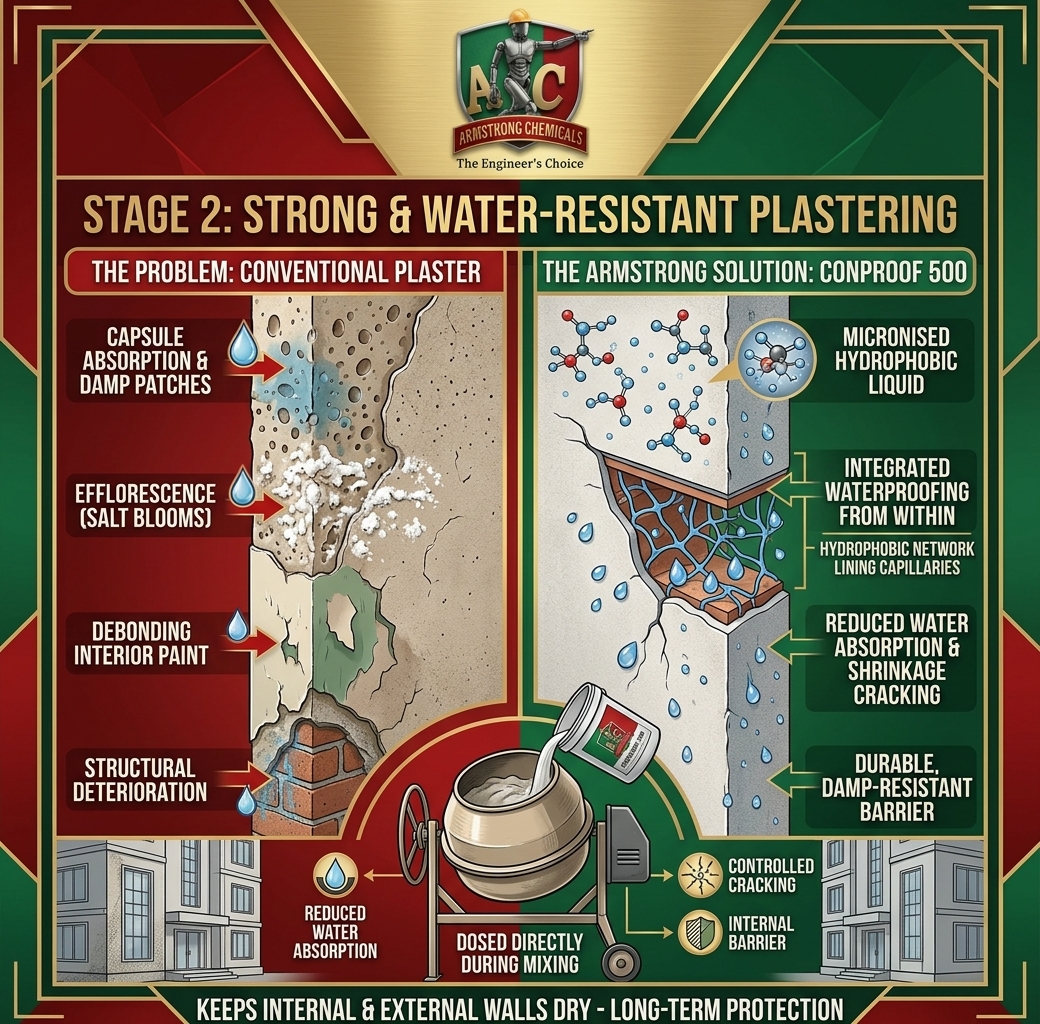
At the newly plastered walls, the customer sees a neat, strong, crack-controlled finish — but good plastering is not merely about appearance. The real objective is to minimise water absorption and improve the long-term protection of the walls themselves.
CONPROOF 500, a Micronised Hydrophobic Waterproofing Liquid, is incorporated directly into the plaster mortar. This gives the plaster hydrophobic protection from within, rather than relying on a surface treatment applied afterward.
CONPROOF 500 — Hydrophobic Protection • Reduced Water Absorption • Improved Durability • Better Protection Against Dampness
Stage 3 — Bathrooms, Wash Areas & Balconies
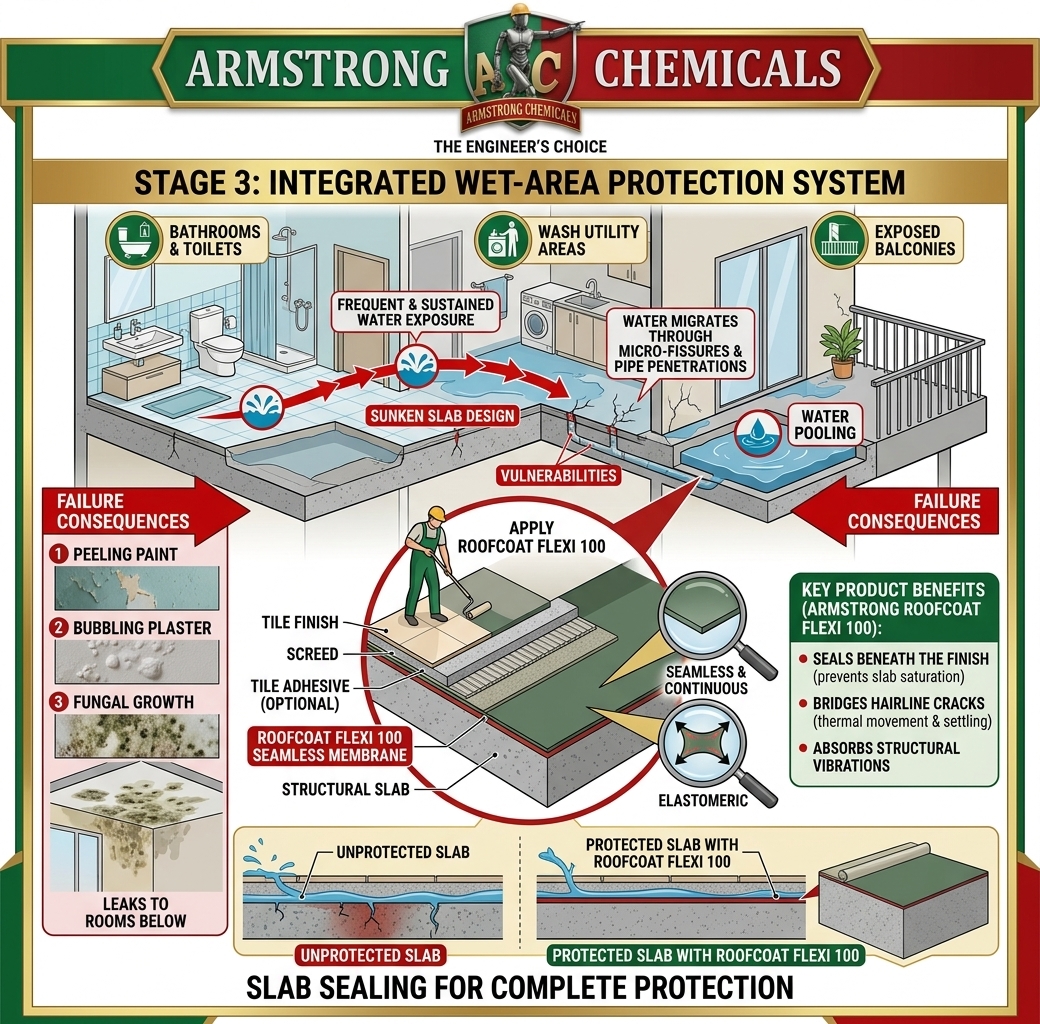
Bathrooms, wash areas and balconies are some of the most leakage-sensitive areas of any apartment — sustained water exposure in a confined space, over years, will find any gap in the waterproofing that exists.
Before tile laying and subsequent finishes, these areas are waterproofed with ROOFCOAT FLEXI 100, an Acrylic Cementitious Elastomeric Waterproof Coating. Its flexible, seamless waterproofing layer provides dependable protection to precisely the wet areas where leaks are most likely to originate and hardest to trace once they occur.
ROOFCOAT FLEXI 100 — Flexible • Seamless • Elastomeric • Dependable Waterproofing
Bathrooms • Toilets • Wash Areas • Balconies
Stage 4 — Tile Fixing & Joint Protection
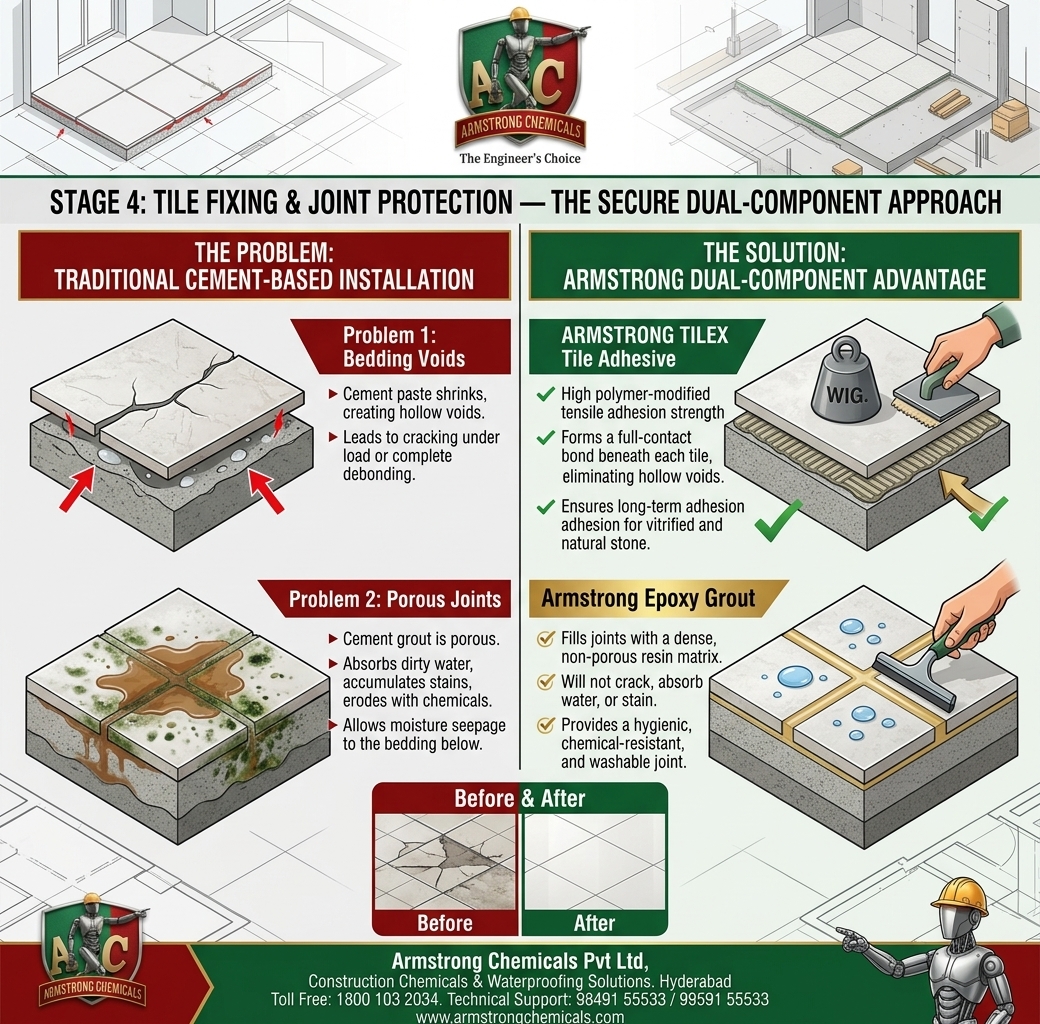
Even expensive tiles can fail prematurely when they are not fixed with the correct system — the tile itself is rarely the point of failure; the adhesive beneath it and the grout between the joints usually are.
The appropriate grade of ARMSTRONG TILEX Tile Adhesive is used for dependable tile bonding, and Armstrong Epoxy Grout is used for the joints, providing strong, dense, durable and easy-to-maintain joints that resist the staining and deterioration ordinary grout is prone to over time.
Tilex Tile Adhesives & Epoxy Grout — Strong Bond • Durable Installation • Better Joint Protection • Professional Finish
Stage 5 — Terrace Waterproofing
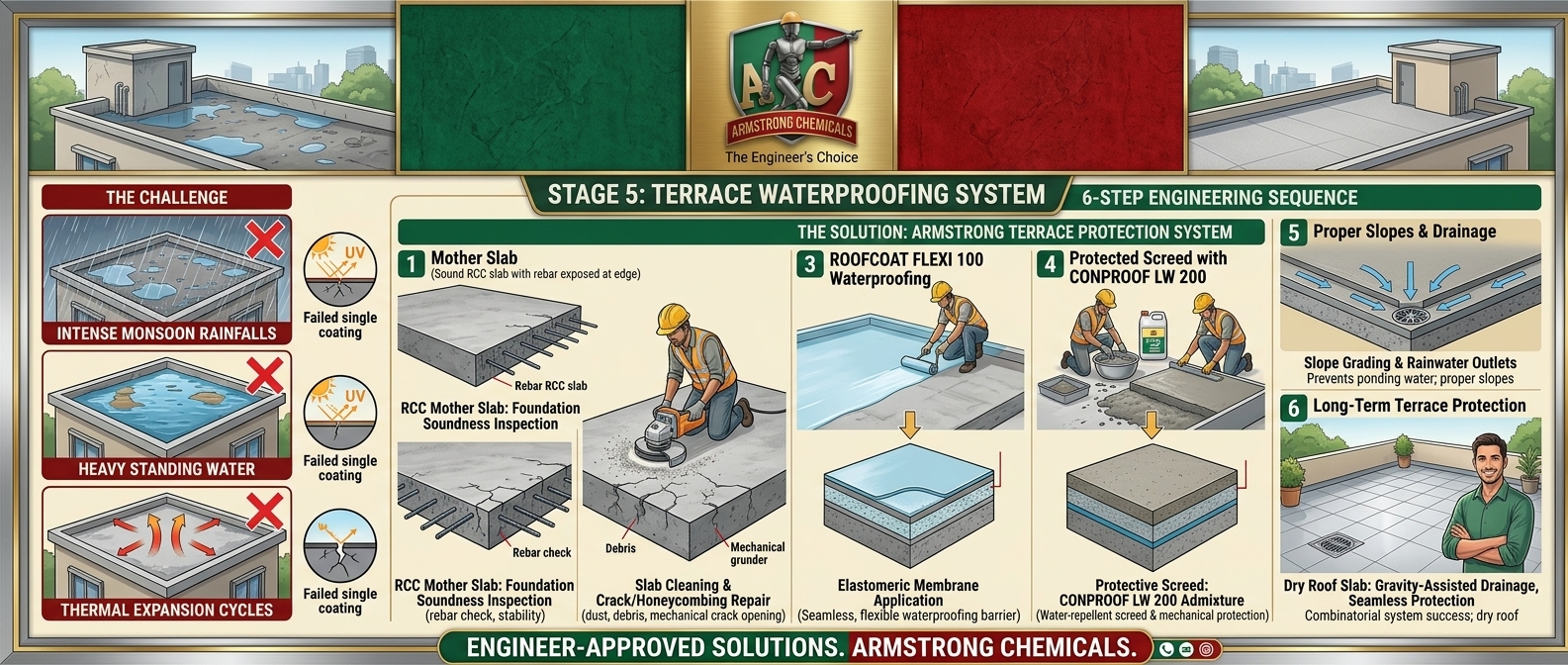
On the open terrace, the walkthrough reaches one of the most important areas for waterproofing in the entire building. The right approach here is systematic, not reactive — the objective is to never wait until leakage occurs and then start repairing it.
On the properly prepared mother slab, ROOFCOAT FLEXI 100 is applied as part of the waterproofing system. The protective screed is then executed with the specified bonding and interface procedure together with CONPROOF LW 200, a Waterproofing Liquid Admixture, while maintaining the required slopes towards the rainwater outlets. The result is a systematic combination of waterproofing, protection and drainage working together, rather than any one measure carrying the whole burden on its own.
Armstrong Terrace Protection System:
- 1. Mother Slab
- 2. Surface Preparation
- 3. ROOFCOAT FLEXI 100 Waterproofing
- 4. Protected Screed with CONPROOF LW 200
- 5. Proper Slopes & Drainage
- 6. Long-Term Terrace Protection
Stage 6 — SummerShield Cool Roof Protection
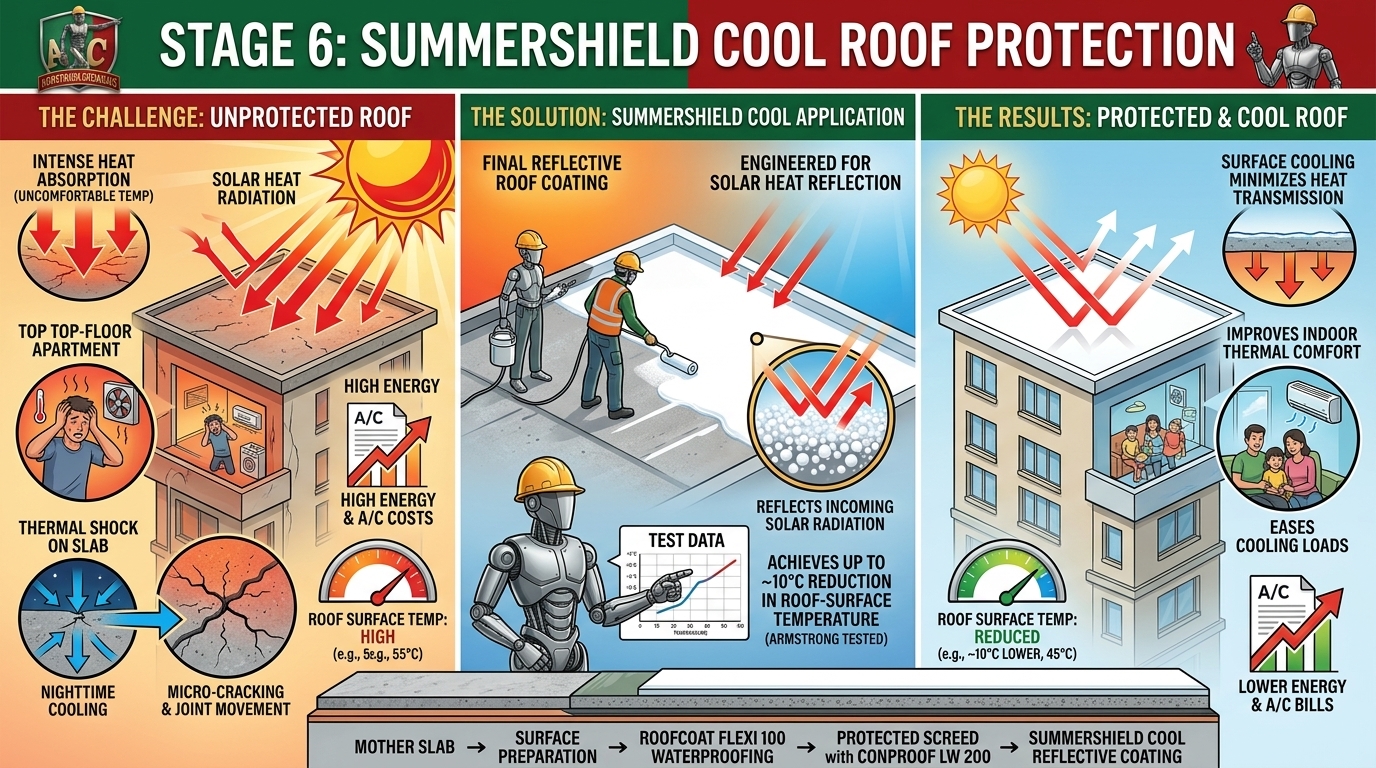
Waterproofing alone is not the full objective on a terrace in Indian conditions — the intense heat transmitted through an exposed roof surface has a direct effect on indoor comfort and, over time, on energy costs.
After completing the terrace to the required slopes and finish, SUMMERSHIELD COOL is applied. Based on Armstrong's own test data, SummerShield Cool can achieve approximately 10°C reduction in roof-surface temperature under the tested conditions, helping reduce heat transmission through the roof and improving indoor thermal comfort.
SummerShield Cool — Up to approx. 10°C roof-surface temperature reduction (Armstrong tested performance)
Solar Heat Reflection • Cooler Roof Surface • Reduced Heat Transfer • Better Indoor Comfort
Performance is based on Armstrong's test data under specified test conditions. Actual site performance can vary with ambient temperature, solar intensity, substrate, coating condition and application.
Stage 7 — Interior & Exterior Wall Protection
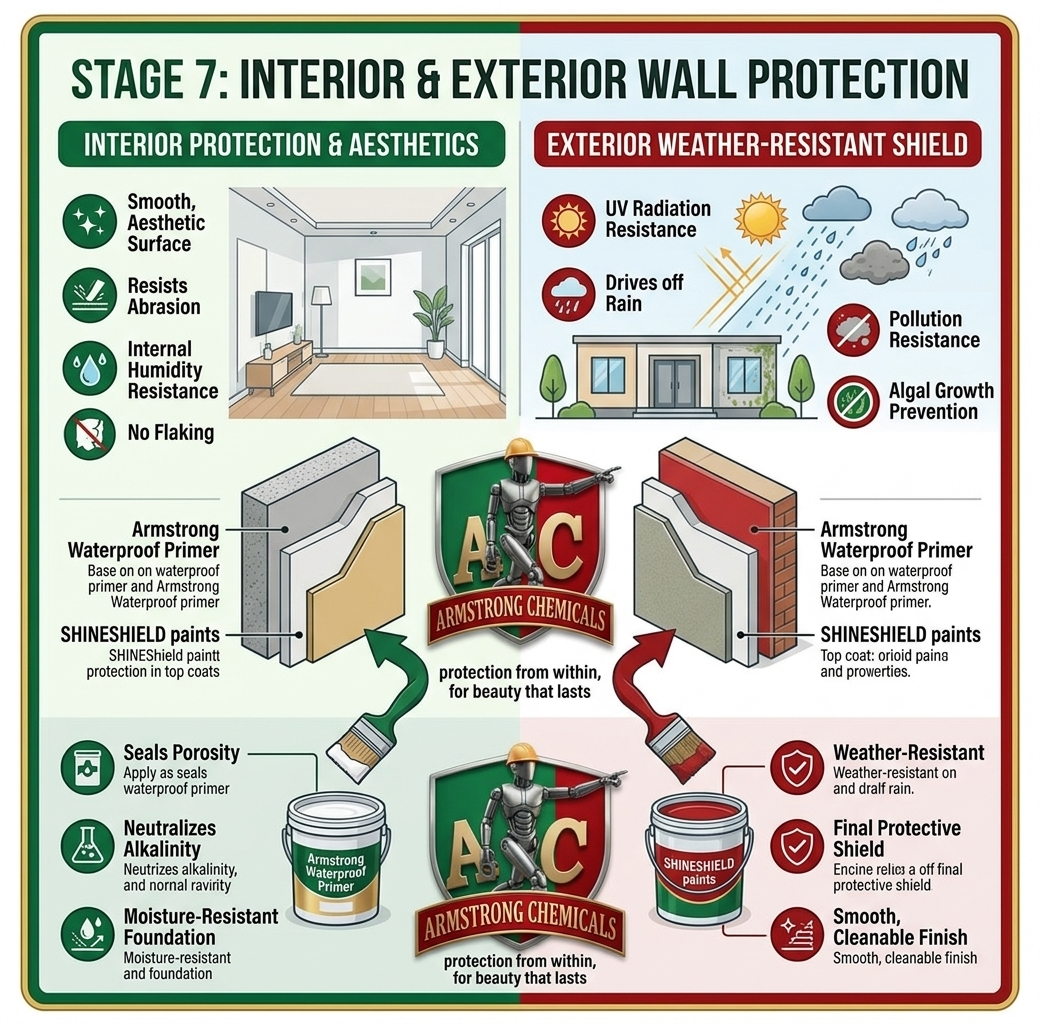
For the final stage, the walkthrough reaches the interior and exterior walls — the surfaces a customer will actually live with and see every day.
Armstrong Waterproof Primer and SHINESHIELD Paints are used for the final protection and appearance of the building, providing an attractive finish together with dependable protection and durability for both interior and exterior surfaces.
Waterproof Primer + SHINESHIELD Paints — Excellent Finish • Beautiful Shine • Weather Protection • Durability • Long-Lasting Appearance
The Full Picture
Standing on the completed terrace at the end of the walkthrough, the difference is now obvious to the customer: Armstrong products have been used throughout the project — from the structural concrete itself, to plastering, wet-area waterproofing, tile fixing, terrace waterproofing, heat protection, and finally painting.
A dependable building cannot be created by waiting for cracks, dampness or leakage to develop and then repairing them. Prevention has to begin at the construction stage itself — which is why the appropriate Armstrong system is selected at every critical stage of construction, rather than treated as an optional add-on once the building is already up. The result is greater confidence in the strength, waterproofing, durability, protection and long-term performance of the finished building.
| Stage | Product System | Function |
|---|---|---|
| 1 | ROOFPLAST PC 455 | Structural Concrete |
| 2 | CONPROOF 500 | Water-Resistant Plaster |
| 3 | ROOFCOAT FLEXI 100 | Wet-Area Waterproofing |
| 4 | Tilex + Epoxy Grout | Tile Fixing & Joint Protection |
| 5 | ROOFCOAT FLEXI 100 + CONPROOF LW 200 | Terrace Waterproofing System |
| 6 | SummerShield Cool | Approx. 10°C Roof-Surface Temperature Reduction — Armstrong Tested |
| 7 | Waterproof Primer + SHINESHIELD Paints | Final Protection & Beautiful Finish |
That is Armstrong's assurance — protecting the building at every stage, from concrete to complete protection.
Planning a new building?
Armstrong's technical team can help specify a stage-by-stage construction and waterproofing system for your project.
Building With Armstrong FAQs
Related Technical Guides
Armstrong Chemicals Pvt Ltd — Construction & Waterproofing Chemicals, Bengaluru
An ISO 9001:2015 Certified Company
© 2026 Armstrong Chemicals Pvt Ltd. All rights reserved.