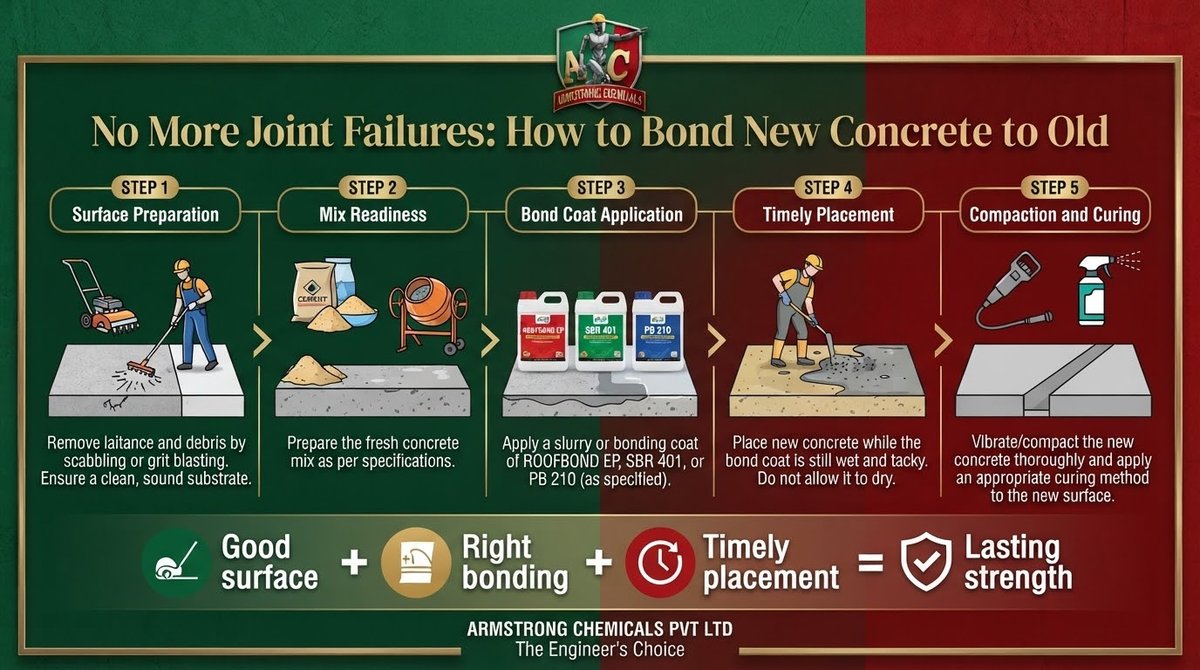
To bond new concrete to old concrete, remove everything loose, roughen the surface, brush on the right bonding agent, and place the fresh concrete, screed or mortar while the bond coat is still wet and tacky. Use ROOFBOND EP where the joint carries load, and ROOFBOND SBR 401 or ROOFBOND PB 210 for repair mortar, screed and plaster. Skip any one of those steps and the joint becomes the weakest plane in the structure.
In most reinforced concrete structures, the weakest plane is not the concrete itself. It is the joint where fresh concrete meets hardened concrete. Slab to beam, beam to column, a column kicker, an extension to an existing floor, a repair patch, a screed over an old slab: each one creates an interface between two materials of different ages, and that interface is where hairline cracks, monsoon seepage, hollow-sounding plaster and debonded screeds begin. Nearly every one of these failures traces back to the same handful of site mistakes, which makes nearly every one preventable. Armstrong's field experience since 1982 comes down to one equation.
Why Joints Between Old and New Concrete Fail
Cured concrete is smooth, dust-coated, chemically inert and often contaminated with form oil or curing residue. Fresh concrete placed against it has no natural grip. Five causes account for the failures Armstrong's engineers see most often on site.
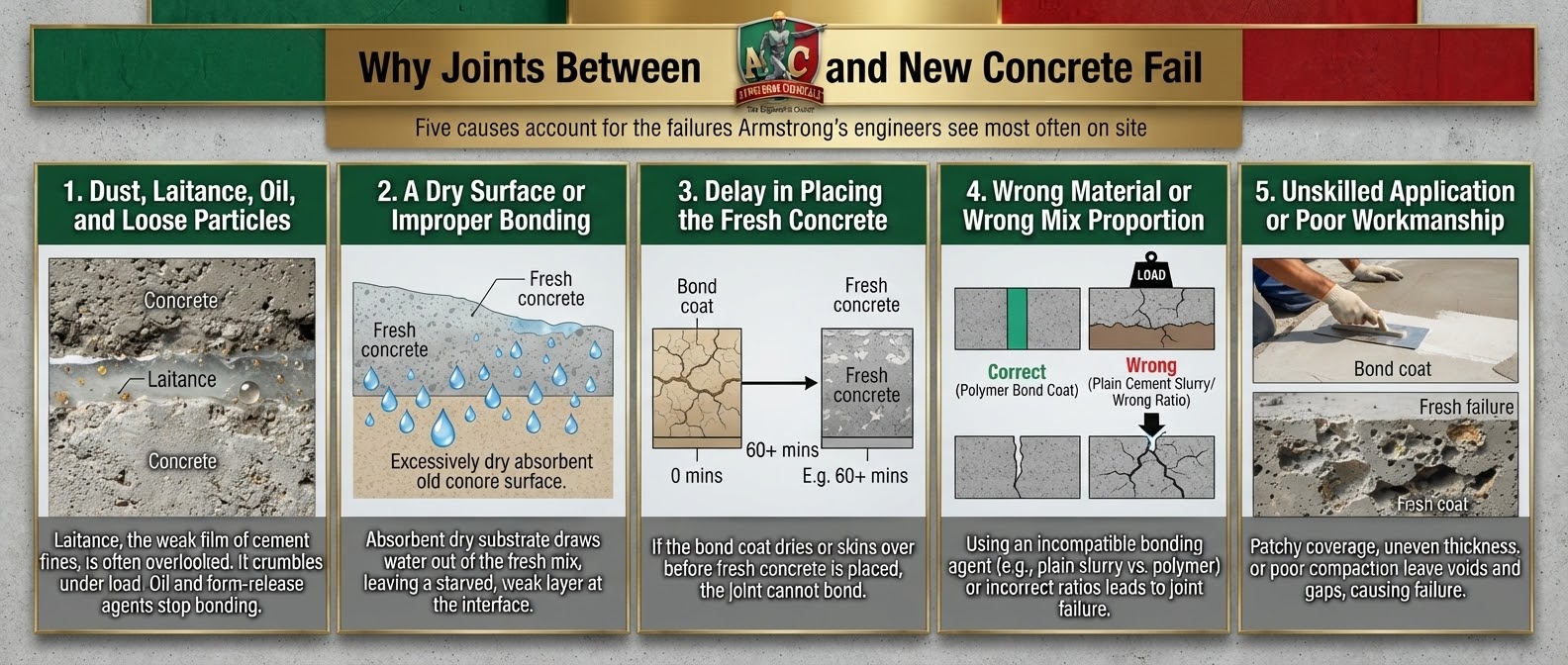
1. Dust, laitance, oil and loose particles. Laitance, the weak film of cement fines that rises to the surface of cured concrete, is the most overlooked of these. A bond made to laitance is only as strong as the laitance itself, which crumbles under load. Oil, grease and form-release agent stop the bonding agent from wetting the surface at all. Whatever is left on the surface becomes the real interface, so the bond can never be better than the dirt it is sitting on.
2. A dry surface or improper bonding. Fresh concrete or mortar placed straight onto a dry, smooth surface with no bond coat has nothing to hold it. An absorbent dry substrate also draws water out of the fresh mix at the interface, leaving a starved, weak layer exactly where strength is needed most.
3. Delay in placing the fresh concrete or mortar. A bond coat has a working window. If the mix is not ready when the bond coat goes on, the coat dries or skins over, and the new concrete is then placed against a film that has stopped bonding: a joint with a layer of dried material trapped inside it.
4. Wrong material or wrong mix proportion. A bonding agent gauged at the wrong ratio, a repair mortar with too much water, plain cement slurry used on a repair, extension or overlay that called for a polymer bond coat, or a general-purpose agent used where the joint is structural. Each of these produces a joint that looks complete and fails under load, thermal movement or water.
5. Unskilled application or poor workmanship. Patchy coverage that leaves uncoated gaps, a bond coat applied thick in some places and starved in others, and poor compaction that leaves voids and honeycombing along the interface. The product can be right and the joint can still fail if the application is not.
Construction joint or cold joint? A construction joint is a planned stopping point in concreting, such as the end of a day's pour or the junction between a slab and a beam. A cold joint is unplanned: fresh concrete is placed against concrete that has already started to set, so the two layers never knit. Supply delays, equipment breakdowns and weather are the usual causes. Treat a cold joint the way you would treat a construction joint: cut back to sound concrete, roughen, clean and bond before placing.
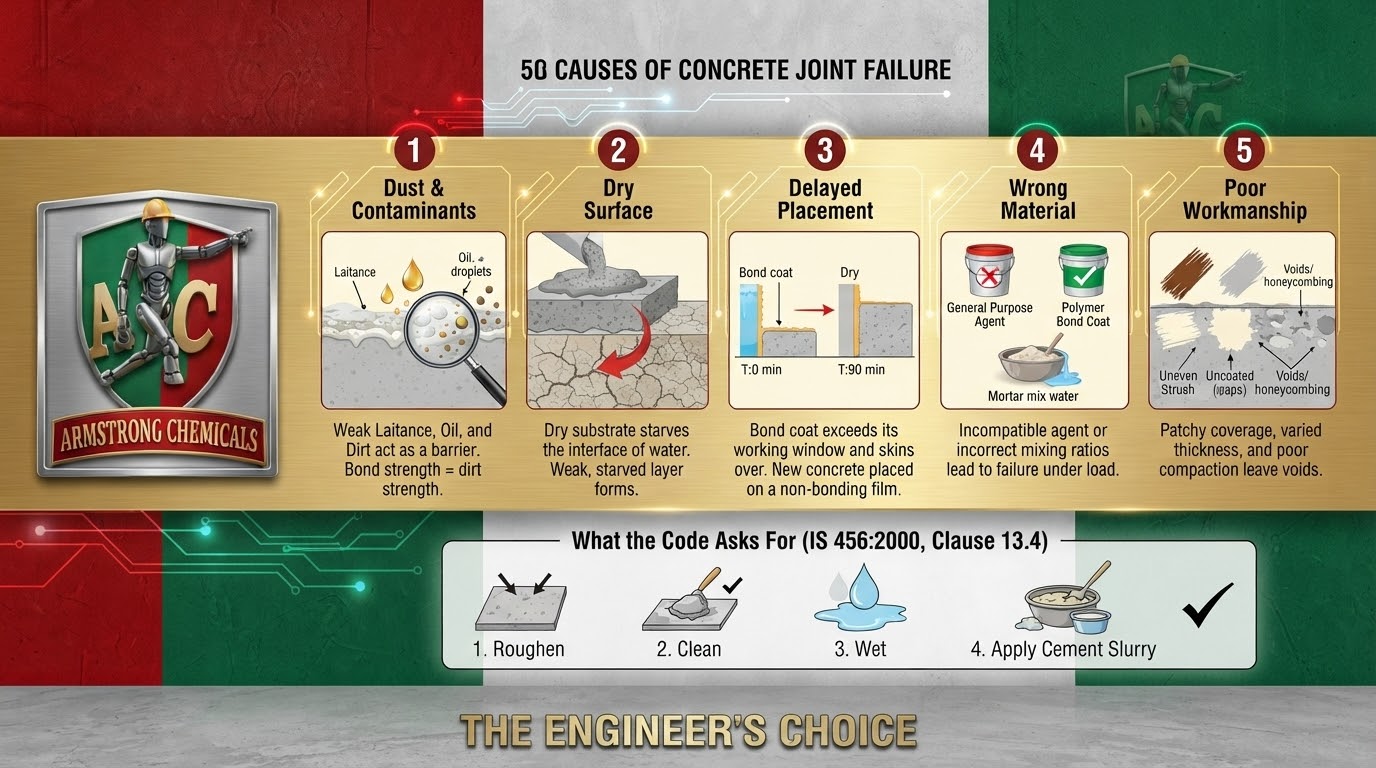
What the code asks for. For work that resumes on hardened concrete, IS 456:2000, Clause 13.4, sets out the baseline: roughen the surface, sweep it clean, wet it thoroughly and apply a coat of neat cement slurry. That is the minimum for an ordinary construction joint. Repairs, extensions to existing members, thin overlays, and any interface that will carry tension, shear, movement or water are where an engineered bond coat earns its place, and that is what the rest of this guide covers.
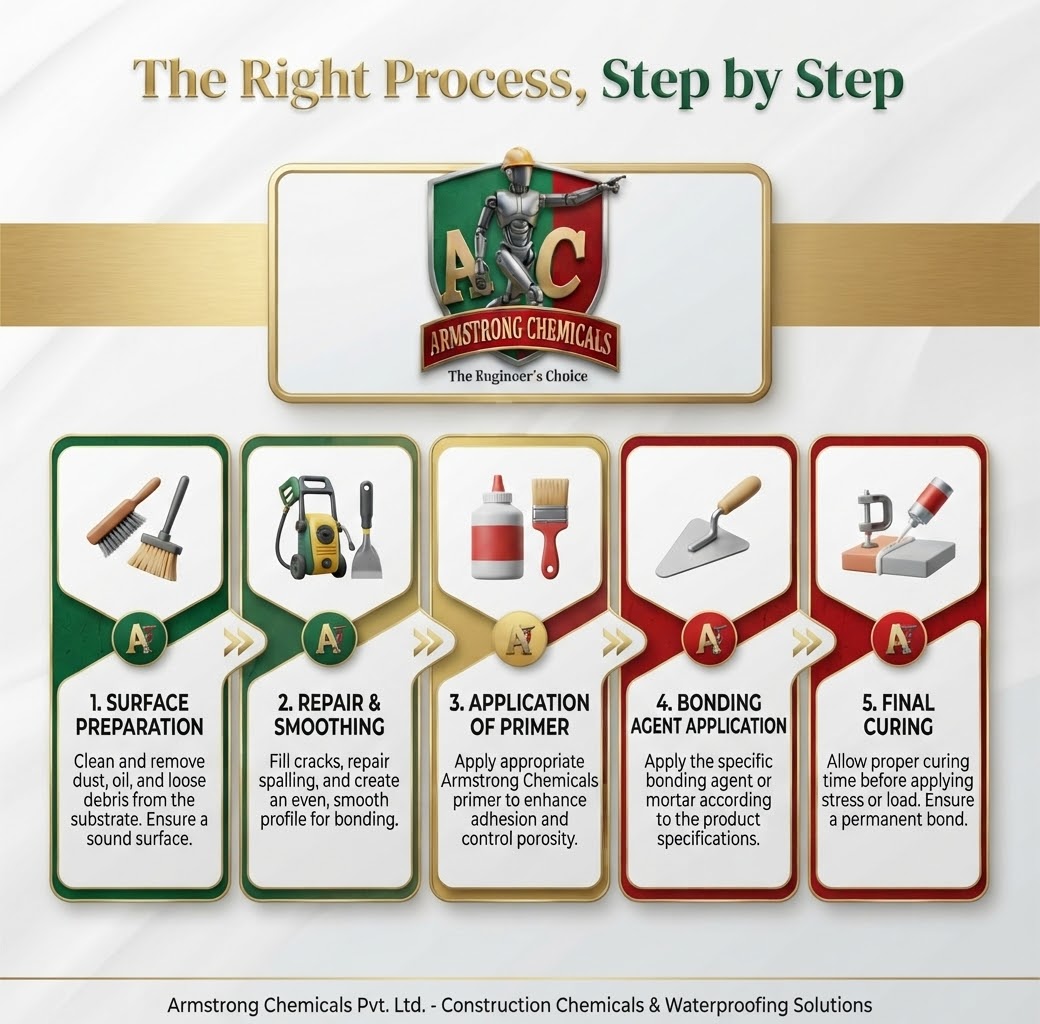
The Right Process, Step by Step
Step 1. Prepare the surface. Remove dust, dirt, oil, grease and every loose particle. Roughen the surface so the new material has a mechanical key: wire-brush light work, and scabble or chip back to sound concrete wherever laitance, a weak surface layer or contamination is present. Blow or wash the surface clean afterwards and clear any standing water. Where the substrate is very dry and absorbent, dampen it so it does not pull water out of the bond coat, and follow the product's data sheet. This is the step that decides the outcome. No bonding agent compensates for a contaminated or weak substrate.
Step 2. Keep the new mix ready. Prepare the fresh concrete, screed or mortar before the bond coat is opened, so there is no gap between the two. Use the correct mix proportion for the application and do not add extra water to make placing easier. For repair mortar, ROOFBOND SBR 401 is gauged into the mix as per the data sheet. In Armstrong's tests a polymer-modified repair mortar reached 63 MPa compressive strength at 28 days, against about 25 MPa for plain mortar.
Step 3. Apply the bond coat. Mix the bonding agent exactly as the manufacturer instructs. For the cementitious systems, ROOFBOND SBR 401 and ROOFBOND PB 210, the bond coat is a slurry of the bonding agent and cement at 1:1 by volume. For ROOFBOND EP, mix base to hardener at 65:35 by volume, mix the whole kit, and batch only what can be placed within the pot life of 90–120 minutes. Apply evenly with a brush, working the coat firmly into the prepared surface so every part is covered, with no dry patches and no pooling. As a guide, EP covers about 2–2.5 m² per kg as a thin film, and an SBR slurry covers 40–65 sq ft per litre of SBR per coat, depending on the substrate.
Step 4. Place while still wet and tacky. Place the fresh concrete, screed or mortar while the bond coat is still wet and tacky. Do not allow the bond coat to dry. With SBR and polymer slurries, placing follows the application straight away. ROOFBOND EP has a longer open window, about 5–6 hours at 20°C and 2–3 hours at 30°C, which is long enough on many jobs to fit reinforcement and formwork after priming. The new concrete still has to go on inside that window, so plan the pour around the shorter figure in hot weather. If a bond coat has dried or skinned over, do not place over it. Re-coat a latex slurry first; if an epoxy has passed its window, contact Armstrong's technical team before going ahead.
Step 5. Compact and finish well. Compact thoroughly to avoid voids, with vibration for structural concrete and careful tamping for screed and mortar, then level and finish to the required surface. Voids and honeycombing along the interface are failure points of their own, even when the bond coat was perfect. Cure the finished work: a curing compound such as ROOFEXCURE WB keeps the fresh material from drying out too fast, so the strength the mix was designed for is actually reached.
Choosing the Right Bonding Agent
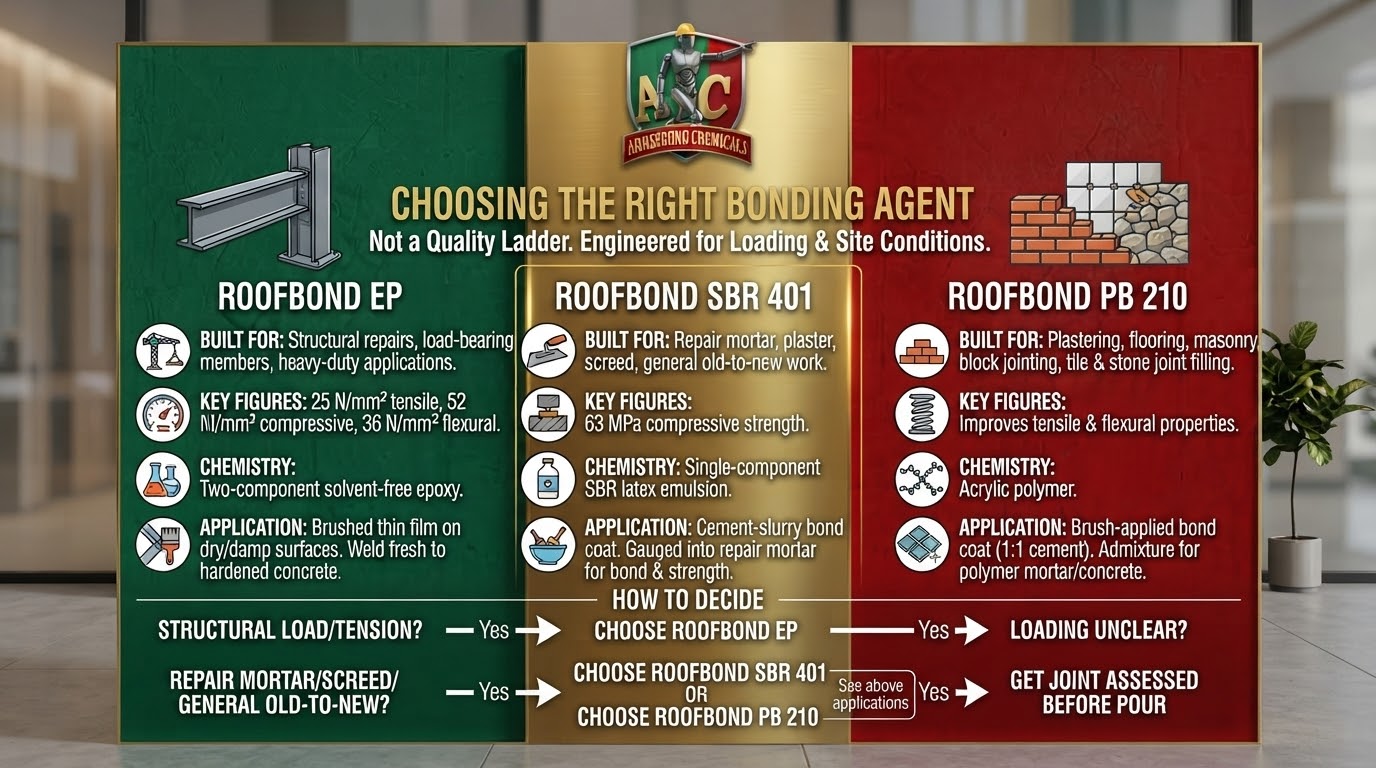
Armstrong's three bonding agents are not a quality ladder. Each is engineered for a different loading and a different site condition, and the right one is the one that fits the joint.
| ROOFBOND EP | ROOFBOND SBR 401 | ROOFBOND PB 210 | |
|---|---|---|---|
| Chemistry | Two-component, solvent-free epoxy | Single-component SBR latex emulsion, 42% solids | Acrylic polymer |
| Built for | Structural repairs, load-bearing members, heavy-duty applications | Repair mortar, plaster, screed, general old-to-new work | Plastering, flooring, masonry and block jointing, tile and stone joint filling |
| Mix and use | Base to hardener 65:35 by volume; pot life 90–120 minutes; brushed thin film, about 2–2.5 m² per kg; dry or damp surfaces | Slurry bond coat at 1:1 with cement by volume; also gauged into mortar, screed and plaster; about 40–65 sq ft per litre per coat | Bond coat at 1:1 with cement; or 1–5 litres per 50 kg bag of cement as an admixture; applied by brush |
| Key figures | 25 N/mm² tensile, 52 N/mm² compressive, 36 N/mm² flexural | 63 MPa compressive and 9.0 MPa flexural at 28 days in tested repair mortar (plain mortar about 25 MPa) | Improves tensile and flexural properties; compatible with all types of cement |
| Working window | About 5–6 hours at 20°C, 2–3 hours at 30°C | Place immediately on the wet bond coat | Place immediately on the wet bond coat |
ROOFBOND EP: for structural joints. Ordinary structural concrete has a tensile strength of only 2–5 N/mm². ROOFBOND EP's own tensile strength is 25 N/mm², so in a loaded joint the original concrete gives way before the bond does. It welds fresh concrete overlays to hardened concrete, dry or damp, and acts as a barrier against chloride ions migrating towards the reinforcement. It is documented to AS 4020:2018 (AWQC Report 32319). Armstrong specifies it as the bonding coat ahead of structural reinstatement mortars such as ROOFCRETE AR 576 in beam and column repairs, and it is the primer partner for the ROOFCRETE EP epoxy mortar.
ROOFBOND SBR 401: the repair and screed workhorse. A white, chloride-free SBR latex emulsion that does two jobs: a cement-slurry bond coat, and a modifier gauged directly into repair mortar, screed and plaster to improve bond, tensile and flexural strength. It reduces the permeability of the cured mortar, which helps limit attack by water, acid gases and aggressive chemicals, and it is compatible with all types of cement. It also gives waterproofing properties to screed and plaster.
ROOFBOND PB 210: polymer bonding for plaster, flooring and masonry. An acrylic polymer bonding agent for bonding old concrete to concrete or plaster, for brick and block jointing, and for stone and granite masonry. It is applied by brush after thorough surface preparation, used at 1:1 with cement as a bond coat, or at 1–5 litres per 50 kg bag of cement as an admixture where polymer mortar or concrete is needed. It also suits filling tile, granite, marble and stone joints with cement and fine sand.
How to decide. If the joint carries structural load or tension, such as a beam or column repair, a loaded extension or heavy-duty work, choose ROOFBOND EP. For repair mortar, screed and plaster, and general old-to-new work in cementitious systems, choose ROOFBOND SBR 401 or ROOFBOND PB 210 according to the application above. When the loading is unclear, get the joint assessed before the pour. Changing the bond system afterwards means breaking out finished work.
What a Bonding Agent Cannot Do
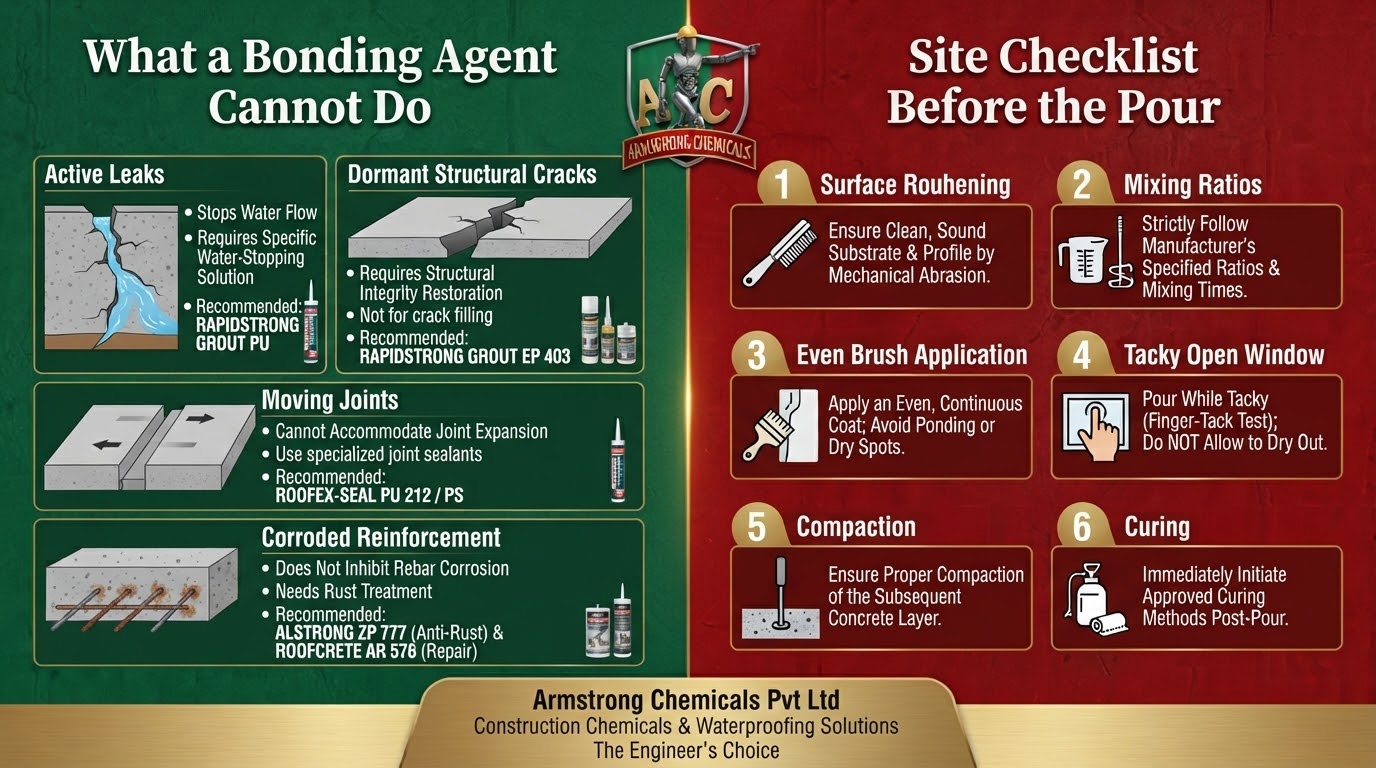
A bonding agent prepares an interface to receive new material. It does not replace the right treatment when the joint itself is defective.
- A joint that is actively leaking needs water-reactive PU injection first. RAPIDSTRONG GROUT PU solidifies within 36–48 seconds of meeting water, even against active pressure.
- A dormant structural crack at a joint is restored by epoxy injection with RAPIDSTRONG GROUT EP 403, after an engineer has confirmed it is dormant. Our Concrete Crack Repair Guide explains how to classify the crack first.
- A joint designed to move, such as an expansion or movement joint, must never be bonded rigid. It takes a flexible sealant such as ROOFEXSEAL PU 212 or ROOFEX-SEAL PS. Bonding agents are for construction joints and cold joints, where old and new concrete are meant to act as one.
Where the problem is corroded reinforcement rather than the joint alone, the repair needs a full sequence: break out to sound concrete, protect the steel with ALSTRONG ZP 777, apply the bonding coat, rebuild with ROOFCRETE AR 576, and cure. The Concrete Crack Repair Guide sets that sequence out for beams and columns.
Site Checklist Before the Pour
- Surface roughened to sound concrete, with laitance, dust, oil, grease and loose particles removed
- New concrete, screed or mortar mixed and ready before the bond coat is opened
- Bonding agent mixed to the manufacturer's ratio, not by eye
- Bond coat applied evenly with a brush, with full coverage and no dry patches
- Fresh material placed while the bond coat is still wet and tacky, and inside the open window for ROOFBOND EP
- Compaction complete, with no voids or honeycombing at the interface
- Finished work cured, not left to dry on its own
- Gloves and eye protection worn, and the product's safety data sheet followed
Prepare well. Bond correctly. Build to last. A clean, roughened surface, the right bonding agent and timely placement give strong joints and stronger structures.
Talk to a Specialist
Free site visit. Armstrong's engineers assess the joint and recommend the right bonding system before you pour.
98491 55533 / 99591 55533 · Toll Free: 1800 103 2034
Related Reading
- Concrete Crack Repair Guide: Walls to Columns: classify and repair the crack before bonding over it.
- Types of Waterproofing Chemicals: A Manufacturer's Guide: the full range, including injection grouts and crystalline systems.
- Screed Over RCC Mother Slab: Technical Guidance: bonded, waterproofed terrace screeds over RCC slabs.
Frequently Asked Questions
By Dr.Ln.Ramana Murty, Armstrong Chemicals
Armstrong Chemicals Pvt Ltd, Construction & Waterproofing Chemicals, Bengaluru
An ISO 9001:2015 Certified Company · The Engineer's Choice
Technical Support: 98491 55533 / 99591 55533 | Toll Free: 1800 103 2034
armstrongchemicals.com