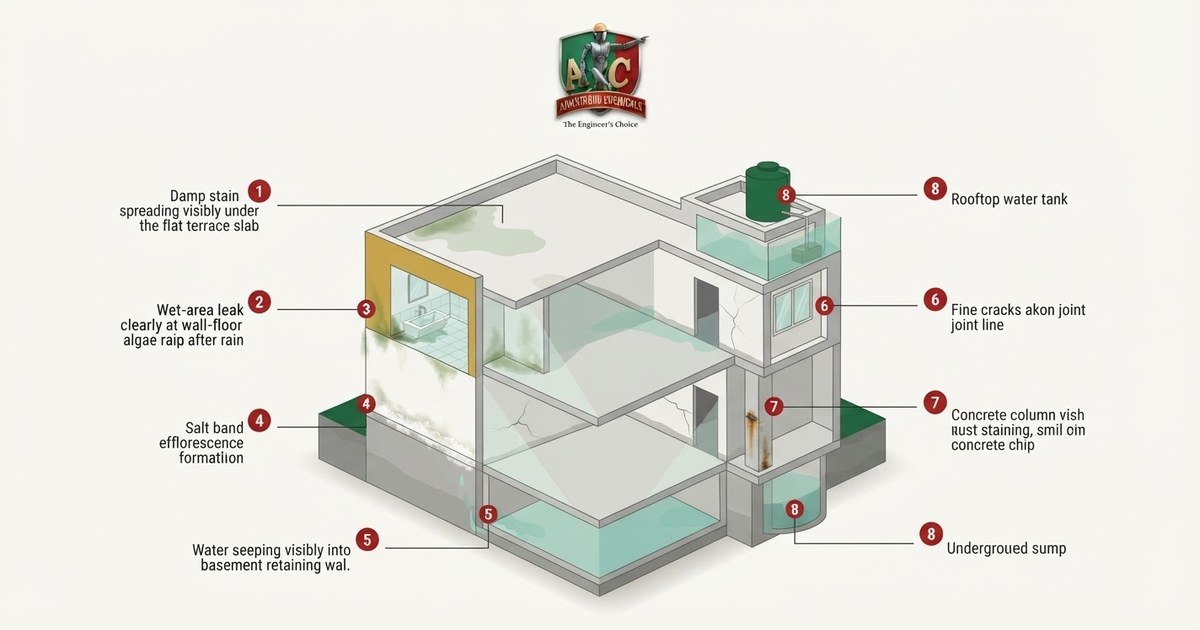
A damp patch on a ceiling, a paint band peeling halfway up a wall, white powder blooming on a fresh plaster finish — owners tend to treat these as three separate nuisances and call a painter. They are not. Each one is a different symptom of water finding its way into, or through, the structure, and each needs a different fix. Treat the wrong cause and the problem returns within a season, usually worse.
Across India's monsoon belt — from Hyderabad and Bengaluru to Chennai, Kerala's coast and Mumbai — buildings face months of driving rain, high humidity and large daily temperature swings. Concrete and masonry expand and contract with that heat, hairline cracks open, and water follows the path of least resistance. This guide walks through the eight most common water problems, what causes each, and the Armstrong system that treats it at the source. For a chemistry-level overview of the products named below, see our guide to types of waterproofing chemicals.
First, Diagnose: Match the Symptom to the Cause
| What you see | What is usually happening | Where to read |
|---|---|---|
| Stains or drips under the roof slab | Cracked, debonded or failed terrace waterproofing; unsealed joints | Problem 1 |
| Damp patches or stains on the ceiling below a bathroom or wet area | Failed membrane at floor, wall-floor junction or pipe penetrations; no flood test before tiling | Problem 2 |
| Patches, fungus, algae after rain | Hairline cracks and porous masonry letting rain in | Problem 3 |
| Peeling paint band, white powder | Efflorescence — salts carried by rising moisture crystallising behind the paint | Problem 4 |
| Water through joints and walls | Groundwater under hydrostatic pressure through joints, cracks and porous concrete | Problem 5 |
| Gaps that let water in | Structural or thermal movement — the entry path for water | Problem 6 |
| Rust stains, flaking concrete | Water reaching reinforcement, which corrodes and expands | Problem 7 |
| Seepage or unsafe water in storage | Porous or cracked concrete in constant contact with stored water | Problem 8 |
Problem 1 — Terrace and Roof Leakage
Why it happens. A terrace is the most exposed surface on any building. Concrete and masonry are dynamic — they expand and contract under fluctuating temperatures — and a rigid coating simply snaps under that movement. Add unsealed cracks, standing water, and UV that turns cheap coatings brittle within 12–18 months, and leakage returns quickly.
How Armstrong treats it. Every system starts the same way: a clean, sound, dry surface, and every crack sealed before the coating goes on — Armstrong's terrace protocol calls for ROOFEX-SEAL PS/ROOFEXSEAL PU 212 sealant on terraces. Then the membrane is matched to the terrace condition:
- RAINSEAL 200 — a single-component, 100% pure acrylic elastomeric coating with 450% elongation at break and crack bridging up to 2 mm. It is breathable (so trapped vapour does not blister it), resists fungus and algae, and reflects 80% of solar heat; in a standard three-coat protocol it lowers internal room temperature by up to about 8°C. Coats are applied 3–4 hours apart, cross-direction, with 3 days of self-curing before foot traffic or a water test.
- RAINSEAL BMW 250 — the brush/mesh-grade elastomeric coat in the same family, built to carry fibre mesh reinforcement across joints and hairline cracks rather than being used as a stand-alone thin film.
- RAINPROOF PU 400 — a single-component polyurethane membrane, seamless and able to be walked on, with 700% (±50) elongation at break and water impermeability to 5 atm (DIN 1048).
- ROOFCOAT FLEXI 100 — an acrylic polymer liquid blended on site with cement and water (1 litre : 2 kg cement : 200 ml water), with 120%+ elongation and coverage of roughly 20–30 sq.ft per litre for two coats, depending on the surface. It bridges static cracks up to 1 mm, tolerates standing water better than most film coatings, and is non-toxic and safe for potable water retention, so the same product is also used in drinking-water tanks (see Problem 8). It is the system of choice where a terrace sees constant moisture — including terrace gardens — rather than just seasonal rain.
- Fibre-reinforced layer systems — when the terrace needs more than a coating. The RAINCARE PRC 5 Layer System is specified for sound, hard terraces with hairline cracks, minor water stagnation and heat build-up: primer, fibre mesh, then three progressively lighter elastomeric coats finishing in a super-white solar-reflective layer. Where the existing screed is debonded, the RAINCARE BRC 6 Layer System is recommended without removing the screed or concrete. For the harshest exposure, the RAINCARE PUA 7 Layer System (hybrid polyurea-polyurethane) is the high-abrasion, heat-resistant option.
- RAINPROOF PWR 690 and RAINPROOF PHW 600 — solvent-free hybrid polyurea/polyurethane systems for terraces and roofs exposed to extreme climatic conditions.
The rule that decides durability: seal cracks first, lay fibre mesh between coats where the system calls for it, and never coat over a wet or dusty substrate.
Layering by site scenario. Armstrong systems are built to be layered, and which combination is right depends on the condition of the terrace, not a fixed recipe:
- Sound concrete, only hairline static cracks (up to about 1 mm): two coats of ROOFCOAT FLEXI 100 on its own is usually enough — no mesh or additional topcoat needed.
- Cracked but structurally sound terrace needing a reinforced, longer-life system: two coats of RAINSEAL BMW 250 with fibre mesh laid between coats to bridge and reinforce the cracks, followed by two finishing coats of RAINSEAL 200 (or another Armstrong protective topcoat — RAINSEAL CFR 613 or SUMMERSHIELD COOL 666 — chosen for the site) for UV resistance, heat reflectance and the final wearing surface. For how cementitious and acrylic coatings compare, see Cementitious vs Acrylic Elastomeric Coatings.
- Debonded screed, or a terrace that needs abrasion resistance for foot traffic: the full RAINCARE PRC 5 Layer System (primer, mesh, three coats) after cracks and debonded areas are patched. Detail: see Screed Over RCC Mother Slab.
- Large flat areas with recurring water stagnation: an acrylic cementitious elastomeric coating such as ROOFCOAT FLEXI 100 is used in place of the standard PRC bituminous-based build-up, since it tolerates standing water better.
- Terrace used for gardening (planters, soil contact, near-constant dampness): use ROOFCOAT FLEXI 100 rather than the standard film-coating system. It is built to sit under constant moisture and damp soil contact without softening or losing adhesion.
The right combination is always a site call — surface condition, exposure and end use decide it — but these are the standard Armstrong building blocks and how they're normally paired.
Problem 2 — Bathroom Waterproofing and Wet-Area Leakage
A bathroom is waterproofed as a sequence: seal the pipe sleeves and joints, form a coved wall-floor junction, apply a two-coat membrane at least 300 mm up the walls, and flood-test for about 7 days before tiling. A skipped step in that sequence — not the wrong product — is the usual reason a bathroom leaks again.
Why it happens. Wet areas fail at their weak points: the wall-floor connection, 90° corners, pipe and drain penetrations, and cracked or unsealed joints. A tile is not a waterproof barrier — the membrane under it is. Most failed bathrooms did not use the wrong product; they skipped a step before it.
How Armstrong treats it. Every system starts with the same preparation, then the membrane is matched to the slab and the water load:
- Seal pipe sleeves and bore holes with RAPIDSTRONG QS and RAPIDSTRONG GROUT ADMIX (free-flow, non-shrink grout).
- Cut a V-groove along every joint and crack and fill with ROOFEXSEAL PU 212 (single-component flexible polyurethane sealant).
- Coved fillet at the wall-floor junction: ROOFBOND SBR bond coat, then 1:4 cement plaster dosed with CONPROOF LW 200.
- Membrane in two coats over the floor and at least 300 mm up the walls, reinforcing wall-floor connections, 90° corners, pipes and outlets with mesh or geotextile.
- Flood-test: hold water for about 7 days before tiling; if dampness shows below, repair and re-test.
The full sequence, including the waterproof base plaster and wall pipe penetrations, is in our Bathroom Waterproofing in New Buildings guide.
Choosing the membrane
All five are Armstrong membranes used in wet areas. Pick by slab condition and water load, not by habit.
| Membrane | Best for | What the datasheet says |
|---|---|---|
| ROOFCOAT PU 2K | Premium under-tile membrane | Two-component PU–cement hybrid; 150%+ elongation; nil water penetration at 5 bar; pre-wetted SSD slab; 2–6 h between coats; air-cure 3–5 days. |
| ROOFCOAT FLEXI 100 | Standard bathroom and sunken-slab membrane | Acrylic polymer cementitious, mixed 1 L : 2 kg cement : 200 ml water; 120%+ elongation; bridges static cracks up to 1 mm; two coats 24 h apart, then 7 days curing. |
| ROOFBOND RFX PLUS 210 | Heavier water load: deep sunken slabs, standing water | Two-part cementitious mixed 1:3 by weight; bridges cracks up to 3.5 mm; nil penetration at a 50 m water column; two coats 2–6 h apart, air-cure 3–5 days; sand sprinkled on the wet final coat before screed or mortar; the brochure lists bathrooms, toilets and sunken portions. |
| RAINSEAL BMW 250 | Toilet sunken portions under brickbat coba or plaster | Single-component acrylic-bituminous, dries black; 500% elongation; ready on moist or dry surfaces; two coats; dry sand on the wet second coat; 6–8 h before coba or cement plaster. |
| RAINPROOF PU 400 | Balconies and wet areas where movement, not dampness, is the main risk | Single-component PU; 700% ±50 elongation; needs a dry slab: moisture ≤5%, cured ≥28 days, no water wash before coating. |
PU 2K and RFX PLUS 210 are applied on a pre-wetted slab, which suits bathroom slabs that are rarely bone-dry. RAINPROOF PU 400 is the high-elongation option, but it only works on a properly dry substrate.
If you choose RAINPROOF PU 400
Its datasheet method is specific:
- Substrate clean, dry, sound; moisture not above 5%; compressive strength at least 25 MPa; new concrete dried at least 28 days; do not wash the surface with water before coating.
- Prime brittle substrate and crack lines as the datasheet directs (RAINPROOF PU 400 PRIME).
- Seal cracks and joints first, then reinforce with geotextile saturated in the membrane.
- Apply by roller or brush, second layer after 12–18 hours (not later than 48 hours), between 5°C and 35°C.
- Reinforce with geotextile at wall-floor connections, 90° angles, pipes and outlets.
- Where tiles will follow, saturate the final wet layer with oven-dry silica sand (0.4–0.8 mm) for an adhesion bridge.
If the membrane is damaged mechanically, the datasheet notes it can be repaired locally within minutes.
Three reasons a bathroom leaks again
- No flood test before tiling — the leak is only found from the ceiling below.
- Membrane stopped at the floor — no upturn on the walls, so splash-back finds the gap.
- New tiles over the old failed layer — re-tiling does not repair what is underneath.
Before blaming the membrane, pressure-test the pipes: a leaking joint in a pipe is a plumbing problem, and no coating fixes it.
Problem 3 — Damp External Walls, Fungus and Algae
Why it happens. Rain penetrates hairline cracks and porous plaster or brickwork. In tropical humidity, that moisture invites fungus and algae, which hold water against the wall and accelerate decay.
How Armstrong treats it.
- Seal first. Cracks on external walls are pre-fortified with WONDERSEAL XL, a highly flexible acrylic latex caulking compound — cut the crack into a V-groove, clean it, and fill.
- Waterproof the surface. Apply RAINSEAL 200 over the sealed wall: it is an exterior damp-proof, liquid-membrane coating for external walls, stone and brick, breathable, and resistant to fungus and algae. Dilute up to 20% for coats; use a 50% dilution only where a primer coat is needed.
- Where the wall should stay uncoated: RAINCARE WR is a transparent, water-based silicone water repellent (mixed 1:10 with water) that protects concrete and mortar against salts, acids and fungal growth while staying breathable and micro-porous.
- Finish. SHINESHIELD Exterior Emulsion — pure acrylic, weather-resistant — carries a 5-year waterproofing warranty when applied over a RAINSEAL 200 or RAINPROOF PU 400 base coat (three coats for dark colours). Paint alone, without the waterproof base, does not give that protection.
Problem 4 — Efflorescence and the Peeling Paint Band
Why it happens. That band of peeling paint 3 to 5 feet up a wall is not random. Ground moisture rises by capillary action carrying dissolved salts with it; the moisture evaporates at that height and the salts crystallise directly behind the paint film. The growing crystals push the paint off from underneath. This is efflorescence — and repainting the same band every year is treating the symptom. For the term in plain language, see the Waterproofing Basics glossary.
How Armstrong treats it. RAPIDSTRONG SALT FLUSHER is an anti-efflorescence primer that works through two mechanisms in one coat: a physical barrier to water transport and a chemical barrier to salt migration. It is based on chemically inert polymers, which is why it suits high-alkaline surfaces such as new concrete.
- Brush off loose particles and apply to a clean, dry surface — concrete, plaster, brick or masonry, internal or external.
- First coat to saturation; second coat after 1–2 hours.
- Coverage: 55–60 sq.ft per litre for two coats; 30–40 microns dry film per coat.
- Topcoat only after 24 hours.
An honest note: a primer blocks salts from reaching the finish, but if a leaking pipe, a failed external membrane or constant ground contact is feeding the wall with water, that source needs treating too. For walls under positive or negative water pressure, the ROOFEX crystalline systems treat seepage and dampness from inside the concrete — pre-dampen the surface, and water-cure thoroughly.
Problem 5 — Basement Seepage and Active Leaks
Why it happens. Below-grade structures sit against groundwater under hydrostatic pressure. Water exploits construction joints, honeycombs, cracks and wall-raft junctions.
How Armstrong treats it — in the right order.
- Stop flowing water first. For active leakage, RAPIDSTRONG GROUT PU — a water-reactive expansive grout — reacts on contact with water and, with a gel time of 0.6–0.8 minutes, solidifies within seconds into a tough adhesive solid that blocks the flow, even in seawater or mildly acidic or alkaline water. It is injected through low-pressure hand pumps (or high-pressure pumps with special packers where conditions require). If natural water at the injection point is insufficient, water is injected too. WONDERSEAL PLUG XL is the instant-plugging option — a hydraulic-setting, expandable compound that stops water flow and sets in about 30 seconds, even underwater.
- Treat the seepage. ROOFEX crystalline systems handle both positive and negative pressure seepage; ROOFEX 2K 711 is specifically suited to negative-pressure conditions including water-retaining structures.
- Waterproof the surface. ROOFBOND RFX PLUS 210, a two-part acrylic polymer modified elastomeric cementitious coating, is used for basements, retaining walls, sea walls, podiums and water-retaining structures.
For a retaining wall specifically — construction-stage concrete design, positive-side systems and the full negative-side sequence — read our Retaining Wall Waterproofing guide.
Problem 6 — Cracks and Joints: The Entry Path
Why it happens. Nearly every leak above starts at a crack or joint. The critical distinction is whether it is moving: a rigid fill in a joint that still moves just cracks again.
How Armstrong treats it.
- Movement joints and moving cracks: ROOFEXSEAL PU 212 — a single-component polyurethane sealant (gun or pour grade, white or grey) with low modulus, primerless adhesion to concrete, masonry, metal and ceramics, and good UV and fungal resistance. Cut a V-groove, clean, fill. ROOFEX-SEAL PS (two-part polysulphide) suits potable-water structures and expansion joints.
- Wall cracks: WONDERSEAL XL (acrylic latex, paintable), or the powder-form RAPIDSTRONG CRACK SEALER 85 / RAPIDSTRONG CRACK SEALER 75, mixed with water.
- Structural cracks and voids: epoxy and cementitious injection grouts — RAPIDSTRONG GROUT EP 403 (low-viscosity epoxy, deep capillary penetration) and ROOFCRETE AR micro-concretes for filling and strengthening.
- Expansion joints: RAINSEAL FLEX TAPE, and the joint-detailing method in the RAINPROOF PU 400 datasheet — geotextile saturated in membrane, a backing rod, then sealant.
Problem 7 — Rust Stains, Cracking and Spalling Concrete
Why it happens. Once water reaches reinforcement steel, it corrodes; the rust occupies more volume than the steel, cracking and flaking the cover concrete — and opening the door to more water. What looks like a cosmetic ceiling patch is a structural warning.
How Armstrong treats it. The reinstatement sequence protects the steel first, then rebuilds around it:
- Chip out deteriorated, loose concrete; clear debris; clean the surface.
- Apply ALSTRONG ZP 777 — a zinc-rich, penetrative primer and rust encapsulator for steel.
- Apply ROOFBOND SBR 401 latex bonding agent, mixed with cement per specification.
- Lay ROOFCRETE AR polymer-modified reinstatement mortar.
- Immediately cure with ROOFEXCURE WB curing compound.
Problem 8 — Drinking Water Tanks, Sumps and Reservoirs
Why it happens. A tank or sump is a waterproofing job with a stricter brief than any other surface on site: it holds water constantly rather than shedding it, so any porosity or crack becomes a permanent seepage path, and — for a drinking-water tank — every product touching the water has to be non-toxic and food-neutral. A coating that is perfectly fine on an external wall can be the wrong choice inside a tank if it is not rated for constant water contact or potable-water safety.
How Armstrong treats it.
- Seal cracks first, with the right sealant for water contact. Cracks wider than 2 mm are cut into a groove and sealed. For a water-retaining structure this is usually done with a cementitious epoxy putty — CONPROOF EP mixed with OPC/white cement and silica powder — rather than a standard sealant, because it stays sound under constant water contact and is safe where the structure will later hold drinking water. ROOFEX-SEAL PS (two-part polysulphide) is Armstrong's other joint sealant rated for potable-water structures and expansion joints.
- Waterproof the tank interior. CONPROOF EP — a two-component, food-neutral, water-thinnable epoxy coating — is applied in two brush coats (6–8 hours apart), each diluted with water, directly on the tank's interior concrete or masonry, including damp surfaces. It cures for a minimum of 24 hours before the tank is filled, and the tank is then washed out with plenty of water before drinking water is stored. The same product is also used as an epoxy primer coat under other Armstrong systems (RAINPROOF PU 400, RAINSEAL BMW 250 and RAINSEAL RWC 902) where a tank or screed needs extra strengthening before the main membrane goes on.
- Alternative / larger structures. ROOFCOAT FLEXI 100 is non-toxic and its datasheet lists drinking-water tanks among its applications; for sumps, larger reservoirs, underground tanks under hydrostatic pressure and sea-facing or podium water tanks, ROOFBOND RFX PLUS 210 is the higher-spec option: nil water penetration at a 50 m water column, and a brochure that lists drinking-water tanks, sumps and reservoirs and describes it as non-toxic (complying with BS 6920 Part 1). Where a structure holds drinking water, confirm that every associated product and material also meets local drinking-water contact regulations, as the RFX PLUS 210 brochure advises.
The rule for tanks and sumps: treat every crack as a future leak path before coating; where the water is for drinking, use a product whose datasheet lists drinking-water tanks and describes it as non-toxic or food-neutral (CONPROOF EP, ROOFCOAT FLEXI 100 or ROOFBOND RFX PLUS 210); and always cure fully and flush the tank before it goes into service.
Why Repainting Never Solves It
A fresh coat of paint on a damp or leaking surface does three things: hides the stain, traps the moisture, and delays the honest diagnosis. Every treatment above follows the same engineering principle — find the source, seal the entry path, then protect the surface with a system matched to the condition. The finish comes last.
Related Reading
Get It Diagnosed Before You Spend on the Fix
Armstrong Chemicals has been formulating construction chemicals since 1982, is ISO 9001:2015 certified, and has supplied waterproofing and repair products to metro rail projects, hospitals, universities and heritage-structure repairs across India. If you are not sure which system your building needs, our technical team will help you match it to the site.
Water Leakage & Dampness FAQs
For what to put on the wall once the damp is fixed, see the Waterproof Paint Guide.
For a leaking bathroom or toilet, see the Bathroom Leakage Repair Guide.
© 2026 Armstrong Chemicals Pvt Ltd. All rights reserved.